Magic Squares have no practical use as far as I can see but they are fascinating. First thing to say is that a 3 x 3 square has only one solution where all rows, columns and diagonals add up to the magic constant which is 15.
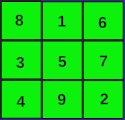
You will find that any other solutions are reflections or rotations so nothing new.
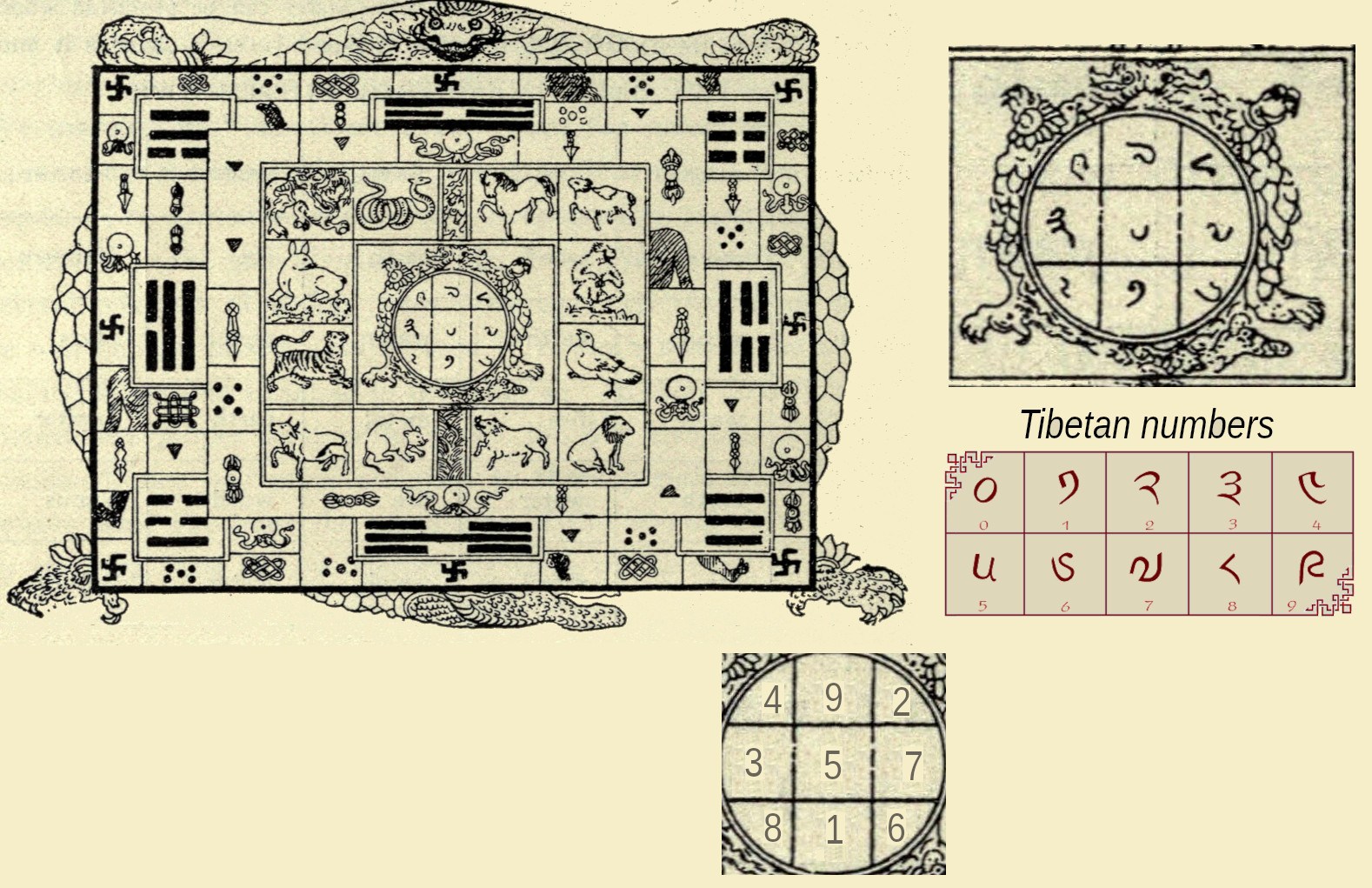
This is an interesting fact. The first magic square in historical times was by a Tibetan monk around 5000 years ago. This is his picture with the square in the middle enlarged and Tibetan numbers shown.
Now this is silver Bedouin amulet which apparently was worn as a charm to ease the pain of childbirth (probably in the time before Mohammad).
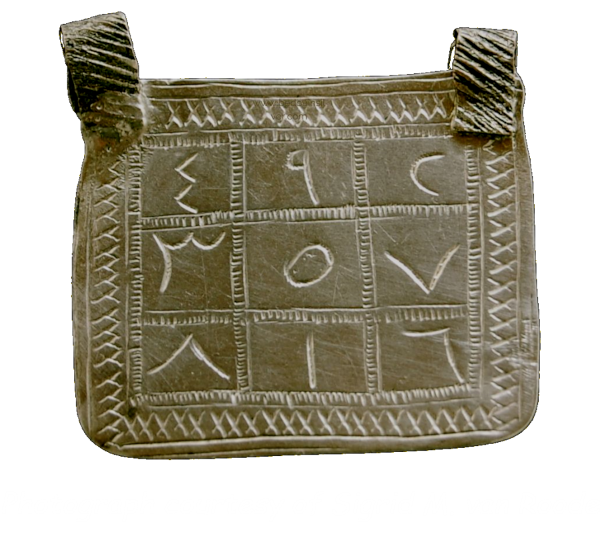
The magic square is called a ‘buduh’ square in Arabic. If the numbers are considered in the Arabic letter/numeric system, the four corners read (right to left of course) 2, 4, 6, 8 or b, d, w, h. It is identical to the Tibetan magic square.
But now lets look at the more interesting 4x4 magic squares.
A pandiagonal or diabolic or just simply a pan-magic square is one in which the broken diagonals have the same sum as the rows, columns, and main diagonals. The magic constant for 4x4 magic squares is 34.
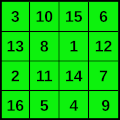
If it is difficult to understand the broken diagonals, imagine a “ghost image” of the pan-magic square next to the original.
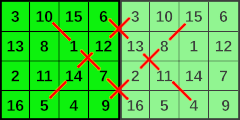
The broken diagonals cross between the two images and as you see all magically add up to 34. But there is even more!
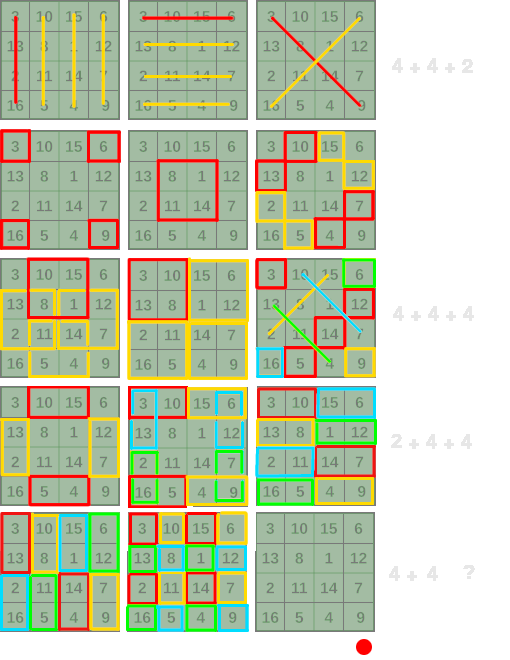
You may wonder how many totals of 34 you can find in a pan-magic square? You may find more but my total so far is 44 adding up like this.
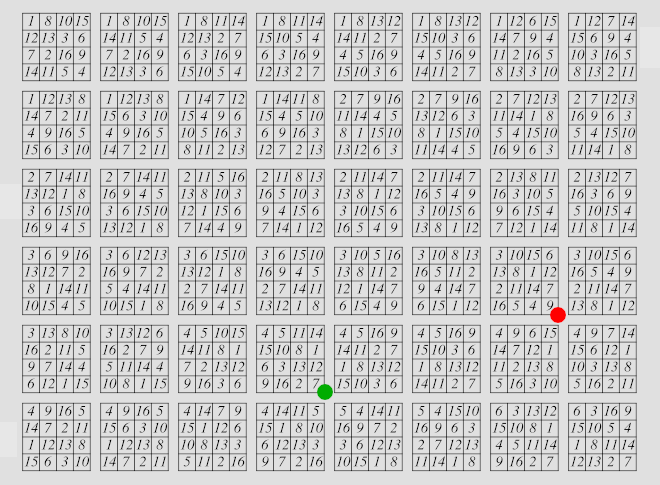
And of course you need to know that out of 880 4x4 magic squares only 48 are truly pan-magic. Puzzler Martin Gardner showed all the pan-magic squares in his puzzle section of the Scientific American magazine in 1988. Each of the answers can be rotated and reflected to give eight variations.
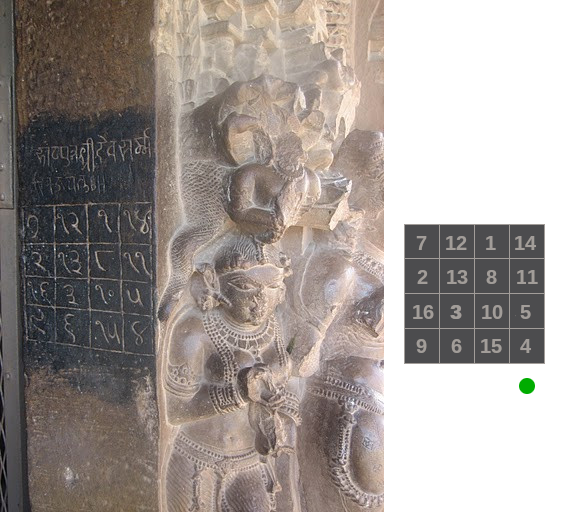
Here is a 10th-century pan-magic square from the doorway of the famous Parshvanatha Jain Temple at Khajuraho, south-east of New Delhi, India.
And a Hebrew nearly pan-magic square on an amulet carried as a talisman against evil. It is held at the British Museum in London, object number OA.1366.
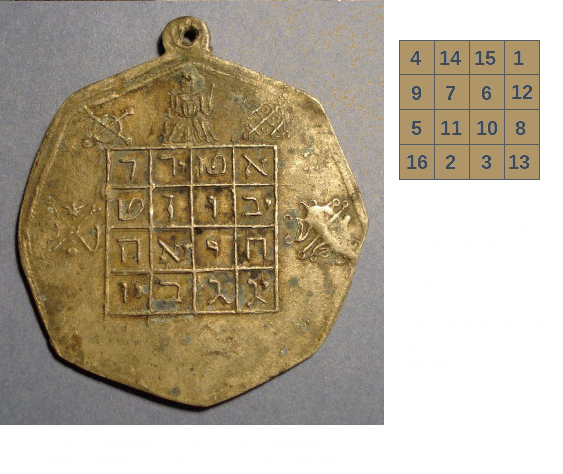
The last word comes from Heinrich Cornelius Agrippa in his book Occult Philosophy in 1651.
It is affirmed by Magicians, that there are certain tables of numbers distributed to the seven planets, which they call the sacred tables of the planets ... The first of them is assigned to Saturn, and consists of a square of three, containing the particular numbers of nine, and in every line three every way, and through each Diameter making fifteen. ... The second is called the table of Jupiter, which consists of a Quaternian drawn into it self [i.e. 4 times 4], containing sixteen particular numbers, and in every line, and Diameter four, making thirty four. Now the Sum of all is 136. And there are over it divine names with an Intelligence to good, with a spirit to bad, and out of it is drawn the Character of Jupiter, and the spirits thereof. They say that if it be impressed upon a Silver plate with Jupiter being powerfull, and ruling, it conduceth to gain, and riches, favour, and love, peace, and concord, and to appease enemies, to confirm honors, dignities, and counsels, and dissolve enchantments if it be engraven on a corall.